Technology

An evidence architecture for one-word domain decisions

Unique Domains observes the domain market as a changing system, not a static table. It captures market, registration, infrastructure, lexical, semantic, and behavioral signals; preserves them over time; reconciles them into current-state decision objects; and uses those objects to support faster, more explainable one-word domain decisions.

Observation layer

Repeated pricing, registration, infrastructure, and telemetry capture.

Canonical state

Historical evidence preserved separately from the fast decision surface.

Typed intent

Search briefs become durable Radar-ready query objects instead of disposable text.

Workflow memory

Judgment, saves, watch states, and follow-up become part of the dataset.

Fig. 0

System notation

D_i
domain entity
S_i,t
time-stamped observation for domain i at time t
C_i
canonical current-state projection
L_i
lexical representation
G
weighted semantic graph
Q_j
typed user-intent object
R(D_i | Q_j)
explainable ranking under intent j

Shared notation keeps the technology figures readable as one connected paper, not isolated diagrams.
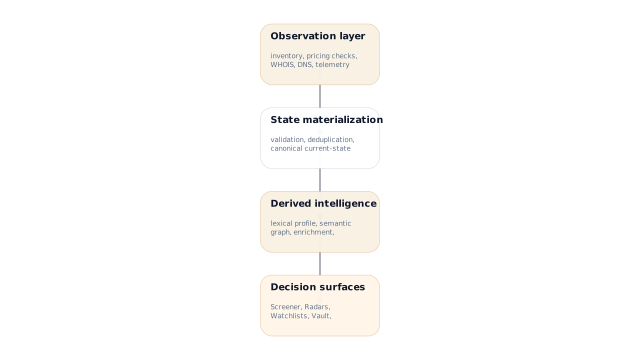
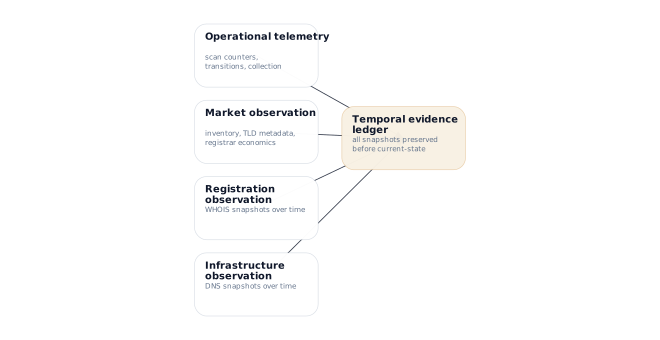
Fig. H1

One saved brief carried through the stack

Q_17

  • Raw brief: "calm, precise one-word brand for workflow automation"

Intent decomposition

  • core terms -> workflow | automation | systems
  • semantic terms -> orchestration | routing | operations
  • filters -> one word | low spelling risk | budget aware

Decision surfaces

  • Radar -> Watchlist -> Vault / Project memory

The page is describing continuity as a system property: the brief becomes typed intent and stays reusable downstream.

I. Problem statement

Why domain discovery becomes unreliable at scale

Raw domain markets are noisy for three reasons. Their state changes over time: pricing, status, registrar path, and technical posture are not fixed. Their linguistic quality is not reducible to availability alone: one-word domains behave as words, brands, and assets simultaneously. And user intent usually begins as a vague brief that must become a precise decision object before it can support tracking or follow-up.

Unique Domains is built around a simple systems thesis: domain decisions improve when raw observations are separated from current-state materialization, and when both are separated from higher-order inference.

Fig. 1

Multi-layer domain intelligence stack

Observation layerinventory, pricing checks,WHOIS, DNS, telemetryState materializationvalidation, deduplication,canonical current-stateDerived intelligencelexical profile, semanticgraph, enrichment,Decision surfacesScreener, Radars,Watchlists, Vault,

Observed evidence, materialized state, and derived interpretation remain separate so the decision surface stays fast and explainable.

II. Data acquisition layer

The system begins with repeated observation, not one-time ingestion

The acquisition layer operates as an evidence capture system with three observation classes. Market observation tracks the domain inventory, TLD metadata, extension-level pricing context, and domain-specific registrar checks. Registration and infrastructure observation treat WHOIS and DNS as repeated snapshots rather than static fields. Operational telemetry turns collection itself into measurable system behavior.

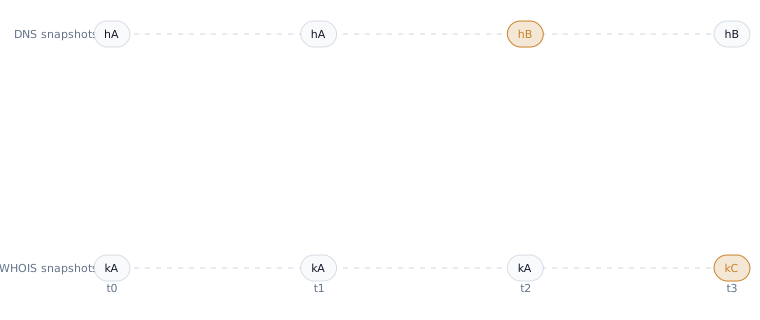
Snapshot hashes act as change detectors, which preserves longitudinal history without inflating history tables with identical states. That keeps the evidence layer compact enough to be operational while still exposing meaningful transitions over time.

Fig. 2

Observation classes

Market observationinventory, TLD metadata,registrar economicsRegistrationobservationWHOIS snapshots over timeInfrastructureobservationDNS snapshots over timeOperational telemetryscan counters,transitions, collectionTemporal evidenceledgerall snapshots preservedbefore current-state

The acquisition layer is defined by repeated observation classes, not a one-shot import of static fields.

Fig. 3

Temporal snapshot preservation

DNS snapshotshAhAhBhBWHOIS snapshotskAkAkAkCt0t1t2t3
unchanged hash
changed hash

Every observation is stored, but only meaningful state changes are allowed to update the current interpretation.

III. State materialization and canonicalization

Historical evidence is preserved; current facts are materialized

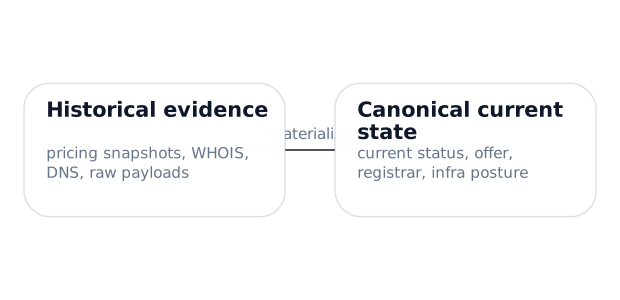
The interface is not asked to compute truth directly from raw snapshots at query time. Historical observations remain in temporal storage, while the most decision-relevant facts are projected into a canonical current-state representation. That projection is what allows the Screener to stay filterable, sortable, and aggregatable at interactive speed.

The same separation applies across pricing, registration, and infrastructure. Historical traces remain available for auditability and longitudinal interpretation. Current-state fields exist to support fast search, ranking, and comparison.

Fig. 4

History versus current state

materializeHistorical evidencepricing snapshots, WHOIS,DNS, raw payloadsCanonical currentstatecurrent status, offer,registrar, infra posture

Historical evidence supports traceability; canonical state supports ranking, filtering, and aggregation.

Fig. 5

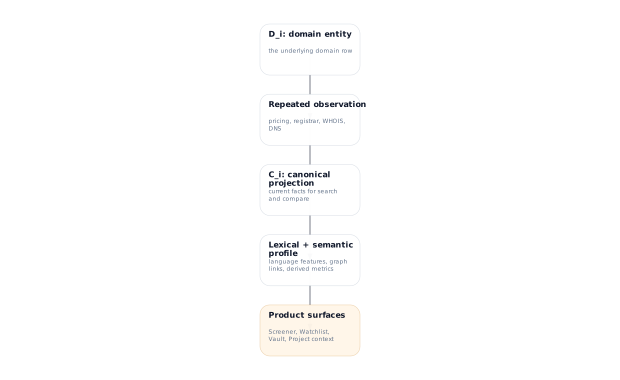
Domain entity lifecycle

D_i: domain entitythe underlying domain rowRepeated observationpricing, registrar, WHOIS,DNSC_i: canonicalprojectioncurrent facts for searchand compareLexical + semanticprofilelanguage features, graphlinks, derived metricsProduct surfacesScreener, Watchlist,Vault, Project context

A domain moves from raw observation to canonical state to derived decision surfaces without losing provenance.

IV. Lexical representation and semantic modeling

A domain is modeled as language, not only as inventory

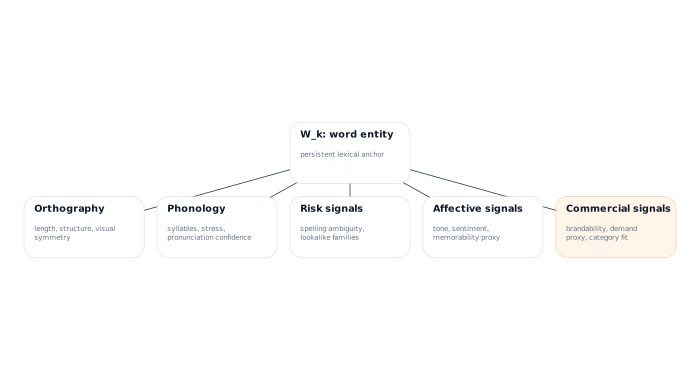
Each domain is decomposed into a lexical unit and assigned a persistent language profile. Orthographic shape, syllabic structure, pronunciation cues, ambiguity, memorability proxies, tone, and commercial fit are represented as measurable features rather than ad hoc UI judgments.

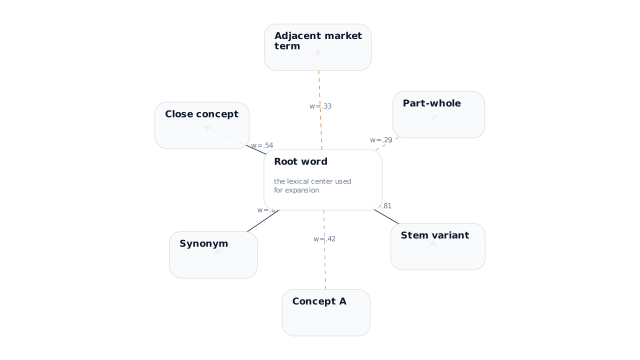
The semantic layer is treated as an explicit weighted graph, not a black-box similarity cloud. That makes expansion controllable: relationships between words and concepts can be constrained, weighted, and explained instead of simply "felt."

Fig. 6

Lexical feature model for a word entity

W_k: word entitypersistent lexical anchorOrthographylength, structure, visualsymmetryPhonologysyllables, stress,pronunciation confidenceRisk signalsspelling ambiguity,lookalike familiesAffective signalstone, sentiment,memorability proxyCommercial signalsbrandability, demandproxy, category fit

The system treats a one-word domain as language, brand, and asset at the same time.

Fig. 7

Weighted semantic graph

w=.81w=.42w=.67w=.54w=.33w=.29Root wordthe lexical center usedfor expansionStem variantConcept ASynonymClose conceptAdjacent markettermPart-whole

Expansion remains explainable because graph neighbors, relation classes, and weights stay explicit.

V. Controlled enrichment and inference

Interpretive layers are applied selectively, validated, and cached

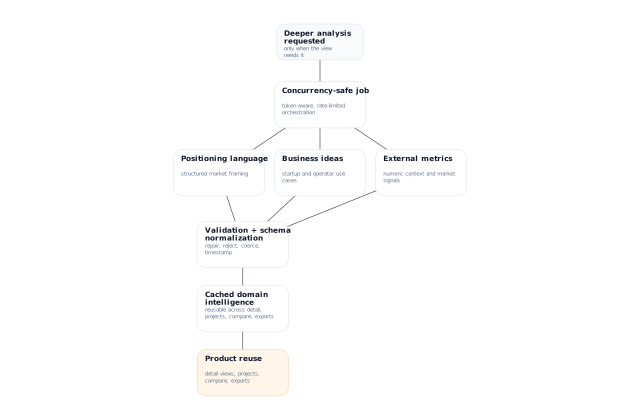
The platform is deterministic where possible and interpretive where useful. Deeper per-domain enrichment is triggered on demand rather than indiscriminately. When a higher-analysis view is needed, the system creates a concurrency-safe job that produces structured outputs such as positioning language, business ideas, external metrics, and valuation context.

Those outputs are not exposed as transient text. They are validated, normalized, timestamped, token-accounted, and stored as reusable product data. Model-generated JSON is treated as untrusted input, and external calls remain quota-aware and rate-limited.

Fig. 8

Controlled enrichment pipeline

Deeper analysisrequestedonly when the viewneeds itConcurrency-safe jobtoken-aware, rate-limitedorchestrationPositioning languagestructured market framingBusiness ideasstartup and operator usecasesExternal metricsnumeric context and marketsignalsValidation + schemanormalizationrepair, reject, coerce,timestampCached domainintelligencereusable across detail,projects, compare, exportsProduct reusedetail views, projects,compare, exports

Higher-cost interpretation is triggered selectively, validated, and cached as structured product data.

Fig. 9

Operational telemetry around enrichment

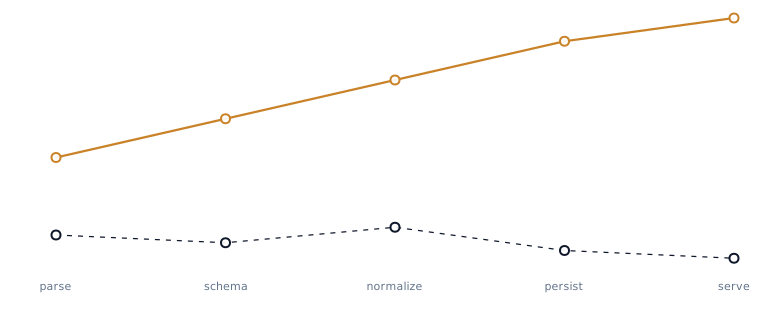
parseschemanormalizepersistserve
validated jobs
retry queue

Interpretive work stays observable: the system can surface where validation is passing, failing, or being retried.

VI. Typed user-intent formalization

A brief becomes a typed query object, not a disposable string

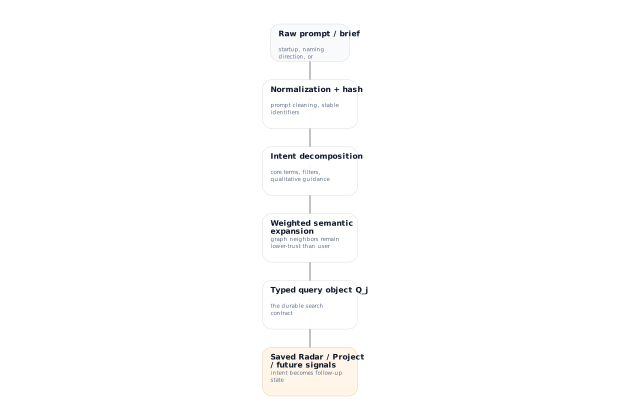
Search itself is treated as data acquisition. When a user describes a startup, naming direction, or investment thesis, the system normalizes the input, hashes it, separates core business terms from expanded semantic terms, extracts structured filters where possible, and preserves any residual qualitative guidance as its own object.

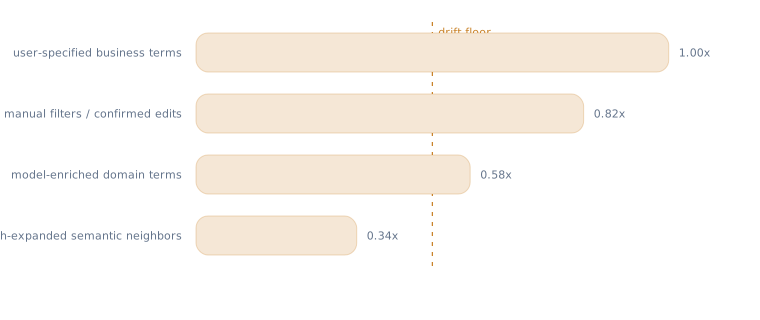
The result is an intent compiler. Direct user terms keep the highest trust, manual filters and confirmed edits retain more weight than model-suggested expansions, and graph neighbors remain available at lower confidence. That preserves fidelity to the brief without collapsing recall.

Fig. 10

User brief to typed intent

Raw prompt / briefstartup, namingdirection, orNormalization + hashprompt cleaning, stableidentifiersIntent decompositioncore terms, filters,qualitative guidanceWeighted semanticexpansiongraph neighbors remainlower-trust than userTyped query object Q_jthe durable searchcontractSaved Radar / Project/ future signalsintent becomes follow-upstate

Search becomes reusable product state once the brief is normalized, decomposed, and saved as a typed query object.

Fig. 11

Semantic weight hierarchy

drift flooruser-specified business terms1.00xmanual filters / confirmed edits0.82xmodel-enriched domain terms0.58xgraph-expanded semantic neighbors0.34x
relative search weight

Confidence stays highest for direct user intent and steps down as the search expands outward.

VII. Workflow memory and behavioral telemetry

The system models user judgment as a second-order dataset

Unique Domains collects not only market evidence but also decision evidence. Searches, row opens, saves, notes, watch states, Radar creation, portfolio entries, and revisit behavior form a behavioral layer on top of the raw market.

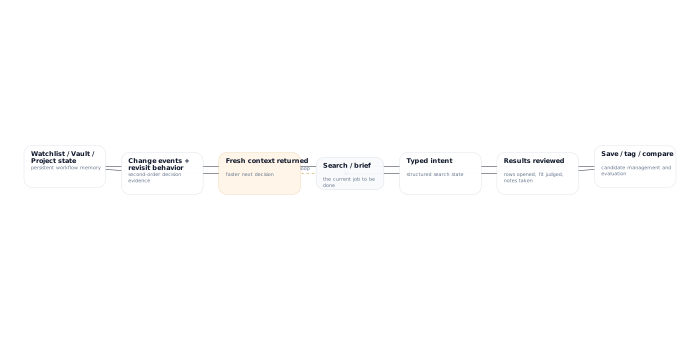
That is how the product becomes continuity rather than browsing. The system remembers what the user was trying to do, what they found worth tracking, and where they were in the decision process so the next decision starts with fresh context instead of a cold restart.

Fig. 12

Decision memory loop

loopSearch / briefthe current job to bedoneTyped intentstructured search stateResults reviewedrows opened, fit judged,notes takenSave / tag / comparecandidate management andevaluationWatchlist / Vault /Project statepersistent workflow memoryChange events +revisit behaviorsecond-order decisionevidenceFresh context returnedfaster next decision

Workflow memory closes the loop: reviewed intent returns as fresh context instead of forcing the next session to restart cold.

Fig. 13

Second-order dataset

intent signals

  • search text
  • filters
  • saved Radars
  • alert cadence

evaluation signals

  • row opens
  • detail review
  • compare states
  • notes
  • tags

tracking signals

  • watchlist saves
  • watchlist changes
  • review states
  • inbox

ownership signals

  • portfolio entries
  • renewals
  • status updates
  • variants reviewed

action signals

  • registrar clicks
  • shortlist commits
  • artifact sharing
  • logs

User judgment becomes its own dataset once searches, saves, revisits, and downstream actions are preserved as evidence.

VIII. Explainability and decision geometry

The output is not a mysterious score. It is a defendable decision surface.

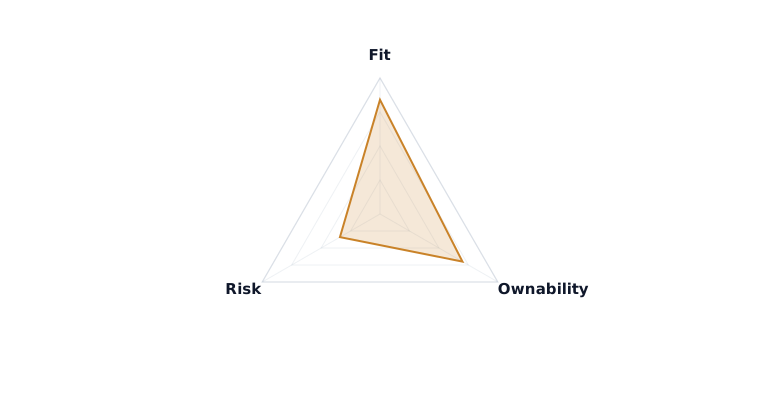
The public abstraction of the system is the same one used across the product: fit, ownability, and risk. Fit is informed by lexical quality, semantic relevance, tone, and strategic use-case alignment. Ownability is informed by pricing state, registrar path, extension alternatives, renewal economics, and acquisition realism. Risk is informed by legal caution signals, history, reputation context, liquidity uncertainty, and technical or market instability.

These axes are not arbitrary. They are a legible projection of the deeper evidence architecture, which is why the final output can be explainable to a buyer without exposing proprietary coefficients.

Fig. 14

The three-axis decision model

FitOwnabilityRisk
defendable decision surface

Fit, ownability, and risk are the public geometry of the deeper evidence system.

Fig. 15

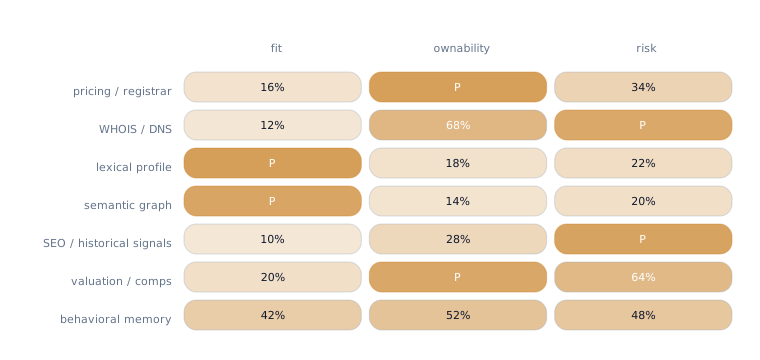
Evidence classes to decision axes

fitownabilityriskpricing / registrarWHOIS / DNSlexical profilesemantic graphSEO / historical signalsvaluation / compsbehavioral memory16%P34%12%68%PP18%22%P14%20%10%28%P20%P64%42%52%48%
secondary contribution
primary contribution

Each evidence family has a dominant contribution, but the model stays cross-linked rather than siloed.

Methodological note

Observed, derived, and interpretive signals stay distinct

Not every signal is of the same type. Some are directly observed, such as pricing, registration, and infrastructure state. Some are derived deterministically through normalization and feature engineering. Others are interpretive and are therefore validated and stored with stricter controls.

This page anchors on the operational backbone that is most real today - discovery, saved intent, tracking, and workflow memory. Founder and studio modules such as Compare, Brand Pack, Setup, Feed, and Insights deepen the system, but they are supportive layers rather than the primary proof of the architecture.

From fragmented domain signals to decision-grade intelligence

Unique Domains is built to make one-word domain decisions feel computationally grounded, operationally continuous, and explainable under scrutiny. The system observes, reconciles, represents, enriches, and remembers - so the user does not have to reconstruct the same decision process from scratch.